

Why Do Some Mouse Problems Seem To Return Again And Again?
For many Clarence Valley homeowners, dealing with mice often starts with a fairly simple plan.
A few traps go down in the garage, some supermarket bait gets placed around the shed, and for a while the activity seems to settle down.
 The scratching noises stop. Fewer droppings appear around storage areas. Things seem quieter for a couple of weeks.
Then suddenly the mice are back again.
Fresh droppings start appearing around the pantry, scratching sounds return inside the ceiling, or new activity begins around sheds and garages despite earlier DIY treatments.
This winter, more homeowners across Grafton and surrounding areas are finding that mouse problems don’t always disappear as easily as they used to.
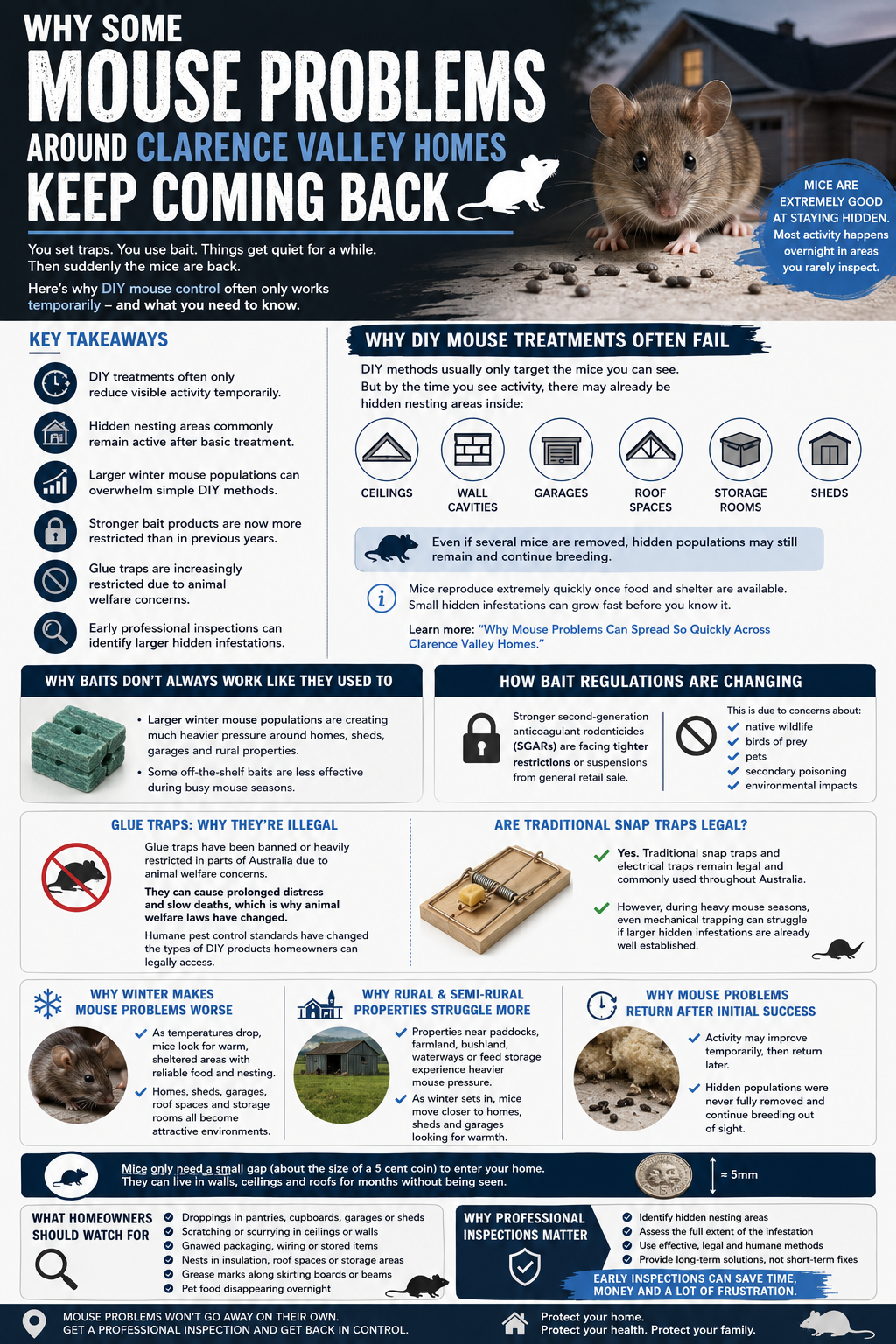
Key Takeaways
- DIY mouse treatments often only reduce visible activity temporarily
- Hidden nesting areas commonly remain active after basic treatment
- Larger winter mouse populations can overwhelm simple DIY control methods
- Some stronger bait products are now more restricted than in previous years
- Glue traps are increasingly restricted due to animal welfare concerns
- Early professional inspections can help identify larger hidden infestations
Table of Contents
- Why DIY mouse treatments often fail
- Why mouse activity can return after baiting
- Why hidden nesting areas matter
- How changing bait regulations are affecting homeowners
- Why winter conditions increase mouse pressure
- Why rural and semi-rural homes often struggle more
- What homeowners should watch for
Why Do DIY Mouse Treatments Often Only Work Temporarily?
One of the biggest reasons mouse problems keep returning is that many DIY treatments only target the mice homeowners can actually see.
Unfortunately, visible activity is often only a small part of the infestation.
By the time mice are regularly appearing around garages, kitchens, sheds, or storage rooms, there may already be hidden nesting areas inside:
- ceilings
- wall cavities
- garages
- roof spaces
- storage rooms
- sheds
That means even if several mice are removed using traps or bait, other hidden populations may still remain active around the property.
Why Are Hidden Mouse Infestations So Common?
Mice are extremely good at staying hidden.
Most activity happens overnight, particularly around quiet areas of the home where homeowners rarely inspect closely.
Because mice reproduce extremely quickly once food and shelter become available, relatively small hidden infestations can continue growing quietly in the background long before homeowners realise the full extent of the problem.
We explore how quickly infestations can spread further in our article:
“Why Mouse Problems Can Spread So Quickly Across Clarence Valley Homes.”
Why Are Some Homeowners Finding Mouse Baits Less Effective?
Many homeowners across the Clarence Valley are also discovering that some off-the-shelf bait products don’t always seem as effective during busy mouse seasons.
Part of this simply comes down to larger mouse populations creating much heavier pressure around homes, sheds, garages, and rural properties this winter.
Have Mouse Control Products Changed In Recent Years?
Yes.
Across Australia, there has been growing regulatory focus around stronger rodenticide products due to concerns about:
- native wildlife
- birds of prey
- pets
- secondary poisoning
- environmental impacts
As a result, some stronger second-generation anticoagulant rodenticides (SGARs) are now facing tighter restrictions or suspensions from general retail sale.
For many homeowners, this has changed the types of products available compared to previous years.
Why Are Glue Traps Illegal In Some Parts Of Australia?
Glue traps have faced growing restrictions across Australia due to animal welfare concerns.
Because trapped animals can suffer prolonged distress and slow deaths, several Australian states and territories have now either banned or heavily restricted glue traps under animal welfare laws.
In NSW and other parts of Australia, increasing focus on humane pest control standards has changed the types of DIY mouse control products homeowners can legally access compared to previous years.
Are Traditional Snap Traps Still Legal?
Yes.
Traditional snap traps and electrical traps remain legal and commonly used throughout Australia as non-chemical mouse control options.
However, during heavier mouse seasons, even mechanical trapping methods can struggle if larger hidden infestations are already well established around the property.
Why Are Winter Mouse Problems Worse Around Clarence Valley Homes?
Winter changes mouse behaviour significantly.
As temperatures continue dropping across the Clarence Valley, mice begin concentrating more heavily around warm sheltered areas where food and nesting conditions remain reliable.
Homes, sheds, garages, roof spaces, and storage rooms all become attractive environments once outdoor conditions become colder and less predictable.
Why Are Rural And Semi-Rural Properties More Vulnerable?
Properties near paddocks, farmland, bushland, waterways, or feed storage naturally experience heavier mouse pressure because mice are already active nearby outdoors.
As winter conditions continue developing, mice begin moving closer toward homes, sheds, and garages searching for warmth and shelter.
We explore the broader seasonal conditions contributing to increased local mouse activity further in our article:
“It’s Only Mid May — So Why Are Mouse Numbers Already Rising Across the Clarence Valley?”
Why Do Mouse Problems Often Return After Initial Success?
One of the most frustrating parts of DIY mouse control is that activity often appears to improve temporarily before returning again later.
For many homeowners, this creates the impression that the mice are “coming back”, when in reality hidden populations may never have fully disappeared in the first place.
Why Is Mouse Re-Entry So Common?
Mice can squeeze through surprisingly small gaps around:
- garage doors
- vents
- roofing
- plumbing penetrations
- wall gaps
- damaged seals
Without identifying how mice are continuing to access the property, infestations can keep rebuilding even after traps or bait reduce visible activity temporarily.
When Should Homeowners Consider Professional Mouse Control?
If mouse activity continues returning despite repeated DIY baiting or trapping, the infestation may already be more established than it first appears.
Recurring signs like:
- fresh droppings
- scratching noises
- damaged packaging
- nesting materials
- recurring sightings
- activity around sheds or ceilings
often suggest mice are continuing to breed or re-enter the property somewhere unnoticed.
Why Is Early Professional Treatment Often Easier?
The earlier infestations are identified properly, the easier they’re usually to control before populations spread further throughout the property.
Professional inspections can also help identify:
- hidden nesting areas
- access points
- ongoing food sources
- activity zones
- conditions attracting mice indoors
before infestations become much larger later in winter.
Need Help With Mouse Problems Around Your Clarence Valley Property?
If you’re already noticing signs of mice around your home, shed, garage, or storage areas, acting early is usually the best way to prevent a much larger infestation developing later in winter.
If you are experiencing mouse problems in the Clarence Valley, contact Hugh from Detecta Pest for professional advice and inspections.
You can also speak with our AI team member Jess 24/7 through the Detecta Pest website or Facebook page. Jess can answer questions, help identify common signs of mouse activity, and even book you in for an inspection anytime.
If you’d prefer, you can also use the enquiry form on the Detecta Pest website to send through an enquiry whenever it suits you.
Frequently Asked Questions
Why do mouse problems sometimes keep returning?
DIY treatments often reduce visible activity temporarily while hidden nesting areas remain active elsewhere around the property.
Why are some homeowners finding mouse bait less effective?
Heavier mouse activity, larger populations, and changing bait regulations are making some infestations harder to control using basic DIY methods alone.
Are stronger rodent baits now restricted in Australia?
Some second-generation anticoagulant rodenticides (SGARs) are now facing tighter restrictions or suspensions from general retail sale due to wildlife safety concerns.
Are glue traps banned in Australia?
Glue traps are restricted or banned in several Australian states and territories because of animal welfare concerns.
Are snap traps still legal?
Yes. Traditional snap traps and electrical traps remain legal and widely used throughout Australia.
Why are rural Clarence Valley properties more vulnerable to mice?
Properties near paddocks, farmland, feed storage, bushland, and waterways naturally experience heavier mouse activity nearby.
What are signs a mouse infestation is still active?
Fresh droppings, scratching noises, nesting materials, gnawed packaging, and recurring sightings usually suggest ongoing activity.
When should I contact a pest controller about recurring mice?
It’s best to arrange an inspection if mouse activity keeps returning despite repeated DIY treatments around the property.